 Ultimate guide
Benefits of Batch Cooking for Busy Families
Table of Contents
- Why Batch Cooking Works for Busy Families
- How to Meal Prep for Beginners
- Batch Cooking Recipes for Families
- Meal Prep Storage Tips for Safety and Freshness
- How Batch Cooking Cuts Grocery Costs and Food Waste
- Building Consistency and Reducing Decision Fatigue
- Conclusion
- Frequently Asked Questions
Last Updated: October 2, 2026
Why Batch Cooking Works for Busy Families
Batch cooking is the practice of preparing large quantities of food in a single session, then dividing it into portions for the days ahead. For households juggling work, school runs, and evening activities, it replaces the daily "what's for dinner" scramble with a system that runs on autopilot. This guide from MealPrepGenius breaks down the benefits of batch cooking for busy families, from grocery savings to calmer weeknights.
How to Meal Prep for Beginners
Start with a single two-hour session and four to five recipes, not a full week of every meal. Beginners who try to prep 21 meals at once usually quit by week two. The realistic entry point is prepping dinners only, then expanding once the routine feels normal.
Essential Equipment for Your First Prep Session
You do not need a chef's kitchen to start. A few workhorses cover almost everything:
- Sheet pans for roasting vegetables and proteins in bulk
- A large stockpot for grains, soups, and stews
- Glass containers with airtight lids in a few consistent sizes
- A digital thermometer to verify cooked temperatures
- Freezer-safe labels and markers for dating every container
A Simple 3-Step Starter Plan
- Choose your proteins and bases. Pick two proteins and two grains or starches that reheat well.
- Cook in parallel. Roast one protein while grains simmer and vegetables roast on a second pan.
- Cool, portion, and label. Divide into meal-sized portions, cool promptly, and date each container.
Expected Result: Four to five dinners ready for the week, with roughly 90 minutes of active cooking.
Batch Cooking Recipes for Families
The best family batch recipes share three traits: they scale cleanly, they reheat without drying out, and they tolerate minor ingredient swaps. Think chili, lentil curry, roasted chicken thighs, sheet-pan sausage and vegetables, and baked pasta.
Adapting Recipes for Dietary Restrictions
Households with mixed dietary needs can still batch cook, but the base-and-add-in method works better than cooking one compromise dish. Prepare a neutral base, then portion it before adding the elements that only some family members eat.
- Keep sauces and dressings separate so gluten-free and vegetarian portions stay clean
- Cook proteins separately from bases when one person avoids meat
- Label containers with allergen and diet notes, not just dates
Meal Prep Storage Tips for Safety and Freshness
Storage is where most batch cooking efforts quietly fail. Food that is cooled slowly, stored too long, or packed while hot creates both safety and quality problems. The USDA FoodSafety.gov guidance on leftovers and food storage recommends refrigerating perishable food within two hours of cooking and keeping the fridge at or below 4°C (40°F). What most guides skip is the how, the specific cooling, freezing, and reheating mechanics that determine whether Tuesday's chili tastes like Sunday's chili or like freezer burn.
Cooling Fast Without Wrecking Texture
The two-hour rule is a ceiling, not a target. The faster food moves through the 60°C to 4°C (140°F to 40°F) range, the less time bacteria have to multiply. But dumping a hot pot straight into the fridge warms everything around it and steams the food into mush. The workaround is portioning into shallow containers no more than 5 cm (2 inches) deep, leaving lids off or ajar until the food stops steaming, then sealing.
Freezing by Food Group
Not everything freezes equally. The texture of high-water-content vegetables collapses when ice crystals rupture cell walls, while dense proteins and sauces hold up well. A practical breakdown:
| Food Group | Freezes Well? | Best Method | Freezer Life |
|---|---|---|---|
| Soups, stews, chili | Yes | Flat freezer bags or rigid containers, leave 2 cm headspace | 2-3 months |
| Cooked grains (rice, quinoa) | Yes | Portion into bags, press flat, squeeze out air | 1-2 months |
| Cooked pasta | Fair | Slightly undercook, toss in oil, freeze in portions | 1-2 months |
| Roasted vegetables | Fair | Flash-freeze on a sheet pan, then bag | 1-2 months |
| Raw potatoes, cucumbers, lettuce | No | Skip freezing; store in fridge and use fresh | , |
| Cooked chicken, ground meat | Yes | Cool fully, portion, vacuum-seal or bag | 2-3 months |
| Sauces, broths | Yes | Silicone trays, then transfer cubes to bags | 2-3 months |
Reheating Without Losing Quality
Reheating is the pain point nobody warns you about. The goal is to bring food back to a safe internal temperature, 74°C (165°F) for leftovers, per USDA guidance, without drying it out or turning it rubbery. The method matters as much as the temperature:
- Stews, curries, soups: Reheat on the stovetop over medium-low, adding a splash of water or stock. Microwave works but stir every 60 seconds so the edges don't overcook.
- Grains: Sprinkle with water, cover, and microwave at 50% power in 30-second bursts. Full power turns rice into pellets.
- Roasted meats: Reheat covered at 150°C (300°F) with a splash of broth, then uncover for the last 5 minutes to re-crisp. Microwaving meat directly is the fastest route to a rubbery texture.
- Pasta and baked dishes: Cover with foil and reheat at 175°C (350°F) until the center reaches 74°C. A splash of sauce on top restores moisture.
- Sauces and broths: Thaw overnight in the fridge, then reheat gently on the stovetop. Boiling a cream sauce can cause it to split.
Labeling That Actually Works
A date alone is not enough. Write the dish name, the date it was cooked, and the reheating method on every container. A roll of painter's tape and a permanent marker costs almost nothing and prevents the classic freezer-roulette problem of unidentifiable blocks of brown. Rotate stock so older containers sit in front, first in, first out.
How Batch Cooking Cuts Grocery Costs and Food Waste
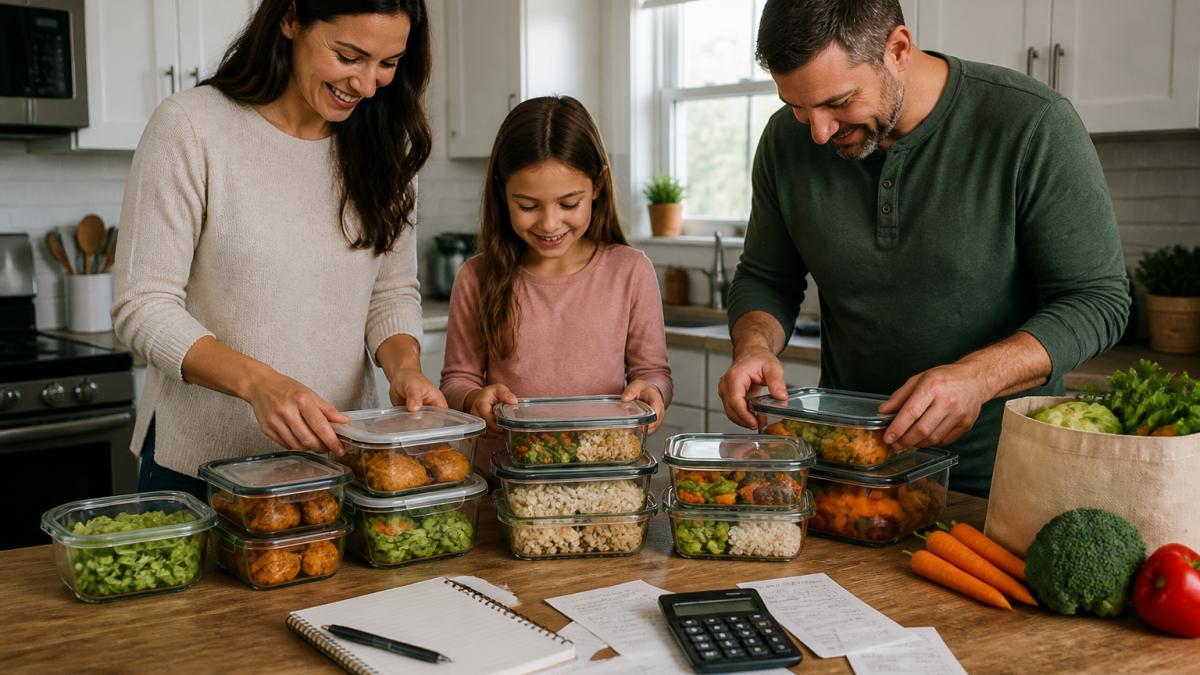
Batch cooking lowers your grocery bill through two mechanisms: buying larger quantities of fewer ingredients, and wasting less of what you buy. When every vegetable has a planned destination, less ends up forgotten in the crisper drawer. But the savings are not automatic, they come from specific habits that separate a batch-cooking household from one that just cooks a lot on Sunday.
The Cost-Per-Serving Mechanism
The math is simple once you see it. A single chicken breast bought in a family pack costs less per pound than the same breast bought individually. A bag of dried beans costs a fraction of the equivalent canned beans and yields roughly three times its dry weight once cooked. A head of broccoli used across three meals costs less than three separate broccoli purchases, and none of it rots.
Where Food Waste Actually Happens
Most household food waste is not spoiled leftovers, it is produce that never got a plan. The half-bunch of celery, the extra peppers, the herbs that wilt before you use them. Batch cooking fixes this by assigning every ingredient a destination before it enters the fridge. If you buy a bunch of parsley, it goes into the tabbouleh, the chimichurri, and the soup garnish, all scheduled in the same week.
A few concrete habits that cut waste:
- Shop from the recipe list, not the aisle. Build your grocery list directly from the week's recipes, then check the pantry before adding anything. This prevents duplicate purchases and impulse buys.
- Prep produce on arrival. Wash, chop, and store vegetables in containers the day you bring them home. Prepped produce gets eaten; whole produce gets forgotten.
- Use a "use-first" shelf. Designate one fridge shelf for items that need to be eaten in the next two days. It becomes the default starting point for any meal.
- Cook staples from dry. Beans, rice, and grains cooked from dry cost less per serving and produce no packaging waste. A pot of beans on the stove while you prep other components adds almost no active time.
- Freeze before it turns. When you realize you won't finish something in time, freeze it, not after it's already questionable. Overripe bananas, wilting spinach, and leftover herbs all freeze well for smoothies, soups, or pesto.
The Hidden Cost of Not Planning
The real expense is not the food you throw away, it is the takeaway you order because nothing is ready. A single unplanned delivery dinner can cost more than a week's worth of batch-cooked ingredients. When dinner is already portioned and waiting, the friction that leads to ordering out disappears. That is the cost-saving mechanism most guides miss: batch cooking does not just reduce what you spend at the store, it reduces what you spend on the nights you would otherwise give up.
Building Consistency and Reducing Decision Fatigue
The biggest hidden benefit is cognitive, not financial. Deciding what to eat every night drains willpower that busy parents need elsewhere. When dinner is already decided and portioned, the 6pm decision disappears entirely.
Conclusion
The hardest part of feeding a family well is not cooking, it is deciding, shopping, and storing under time pressure. MealPrepGenius was built for exactly that gap, with personalized meal plans, automated grocery list generation, and batch-prep task management that turns a vague intention into a scheduled session. Progress tracking keeps your nutrition goals visible while the AI-driven recipe search and coaching handles the customization that manual planning makes tedious.
Frequently Asked Questions
What are the primary benefits of batch cooking for busy families?
Batch cooking saves time by consolidating cooking sessions, reduces grocery costs through bulk buying and less waste, and cuts daily decision fatigue by having meals ready. For busy families, it also supports consistent nutrition and portion control. One parent can prep multiple meals in one session, freeing up weeknights for family time instead of cooking from scratch.
How long does batch-cooked food stay fresh in the fridge?
Most cooked meals stay fresh for 3 to 4 days in the refrigerator when stored in airtight containers. For longer storage, freeze portions for up to 3 months. Always cool food quickly before refrigerating and label containers with dates. Following meal prep storage tips like these helps maintain food safety and quality.
What are the best foods to start with for beginner batch cooking?
Start with freezer-friendly staples: chili, soups, stews, casseroles, and cooked grains like rice or quinoa. These hold up well to reheating and freezing. For families, batch cooking recipes that use pantry staples and fresh ingredients, such as pasta sauces or sheet-pan chicken and vegetables, are easy wins. Avoid delicate items like salads or fried foods for batch cooking.
How does batch cooking help save money on groceries?
Batch cooking reduces grocery bills by letting you buy in bulk, use cheaper cuts of meat, and plan meals around sales. It also cuts food waste because ingredients are used entirely in planned recipes. Cooking at home instead of ordering takeout adds further savings. Many families find that a weekly prep session lowers their cost-per-serving significantly.