 How-to
How to Calculate Nutrition for Recipes Without Guesswork
Last Updated: November 6, 2026
Quick Summary
To learn how to calculate nutrition for recipes, weigh each raw ingredient in grams, look up its calories per 100 g, multiply by the weight used, add the totals, then divide by servings. Calculate totals from raw weights, but set serving size from the cooked weight.
- Weigh raw ingredients in grams and record every amount before you start cooking.
- Use the formula (weight in grams ÷ 100) × calories per 100 g for each ingredient.
- Match the food form, since raw chicken breast is about 165 calories per 100 g.
- For packaged foods, label data beats generic database entries because it reflects the actual product.
- Divide total calories by cooked weight to get calories per gram for portioning.
Table of Contents
- Why Recipe Nutrition Starts With Ingredient Weights
- How to Calculate Calories in Homemade Food Step by Step
- A Worked Example From Ingredient Weights to Per-Serving Results
- What a Free Recipe Nutrition Calculator Can and Cannot Do
- Choosing a Recipe Nutrition Calculator App for Your Kitchen
- Using the MyFitnessPal Recipe Calculator Without Losing Accuracy
- How Cooking Changes Weight, Servings, and Your Final Numbers
- Set Up Your Recipe Nutrition Tracking in MealPrepGenius
- Frequently Asked Questions
Why Recipe Nutrition Starts With Ingredient Weights
Learning how to calculate nutrition for recipes starts with one habit: weighing your ingredients before they hit the pan. Volume measures like cups and spoons leave room for error, a "cup" of chopped carrots depends on how finely you chop them.
People often track carefully and still wonder why their numbers never match their goals. The culprit is usually the measurement, not the math.
Weighing Raw Ingredients Before You Cook
Raw weight is the number you want: consistent, repeatable, and matching most food databases. Cooked weight changes with water loss, adding guesswork.
Here is the workflow we recommend:
- Place your bowl on the scale and press tare to zero it out
- Add each ingredient and record the weight in grams
- Write down every amount before you start cooking
A common mistake is weighing after cooking. Chicken loses water as it cooks, so 200 g raw might weigh 150 g cooked. If you log the cooked weight against a raw-food database entry, your calories come out too low.
Converting Cups and Spoons to Grams
If you only have cups, convert them to grams first, since most nutrition databases list serving sizes in grams.
Rough conversions help, but they vary by ingredient:
| Ingredient | 1 Cup (approx.) | Why It Varies |
|---|---|---|
| Rolled oats | 90 g | Flakes pack loosely |
| White rice, uncooked | 185 g | Grain size and packing |
| Chopped vegetables | 120-150 g | Chop size changes density |
| Flour | 120 g | Sifted vs. packed |
| Nut butter | 256 g | Thick and dense |
For anything scooped, spooned, or chopped, a cheap digital scale beats a conversion chart every time.
How to Calculate Calories in Homemade Food Step by Step
To calculate calories in homemade food, weigh each raw ingredient, look up its calories per 100 grams, multiply by the weight you used, add everything together, then divide by the number of servings. That is the whole method.
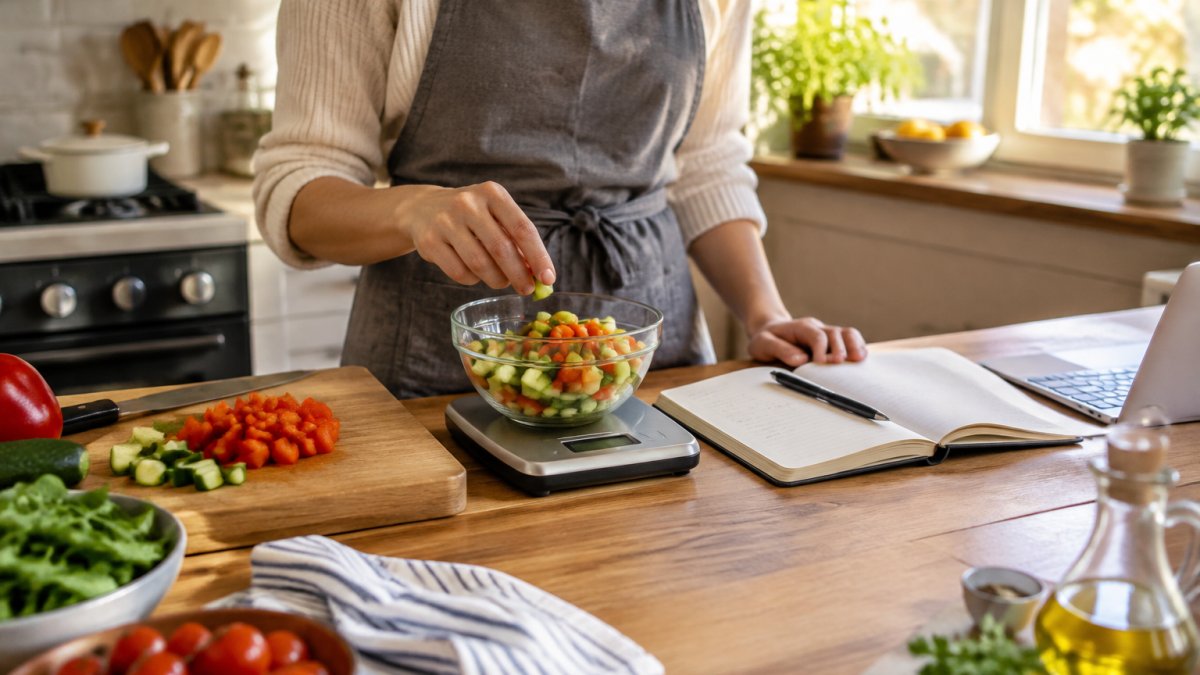
Here is the full process in order:
- Weigh each raw ingredient in grams and write it down
- Find the nutrition value for that food per 100 g in a food database or on the label
- Calculate each ingredient's calories with this formula: (weight in grams ÷ 100) × calories per 100 g
- Add the ingredient totals to get the recipe's total calories
- Divide by serving count to get calories per serving
- Repeat for protein, carbs, and fat using the same weights
Most people skip step three and jump straight to a calculator, which only works if it uses the same weights you did.
Adding Up Ingredient Totals and Dividing by Servings
The division step is where most tracking errors creep in. Serving count is a judgment call, and it changes everything.
Say your finished dish weighs 1,200 g and a serving is 300 g: that gives four servings. If you later eat 400 g, you log 1.33 servings, not one. Weigh the finished dish, then divide by your target portion weight to keep per-serving numbers consistent.
If you want a shopping list built from those weighed ingredients, generate a grocery list from your recipe once your totals are set.
A Worked Example From Ingredient Weights to Per-Serving Results
Numbers make more sense with a real dish.
Ingredients (raw):
- Chicken breast: 500 g
- Uncooked white rice: 200 g
- Olive oil: 20 g
Step 1: Calories per ingredient. Using (weight ÷ 100) × calories per 100 g:
- Chicken: (500 ÷ 100) × 165 = 825 calories
- Rice: (200 ÷ 100) × 365 = 730 calories
- Olive oil: (20 ÷ 100) × 884 = 177 calories
Step 2: Recipe total. 825 + 730 + 177 + 102 = 1,834 calories.
Step 3: Per serving. If the dish makes four servings, that is 1,834 ÷ 4 = about 459 calories per serving.
Run the same weights through protein, carbs, and fat for a complete nutrition panel.
What a Free Recipe Nutrition Calculator Can and Cannot Do
A free recipe nutrition calculator matches your ingredients to a food database and totals calories and macros for you. It saves time but does not remove the need for careful input.
What these tools do well:
- Match ingredients to database entries fast
- Convert units and scale amounts automatically
- Total calories, protein, carbs, fat, and often fiber and sodium
Where they fall short:
- Database matching is imperfect. "Chicken breast" might return raw, cooked, skinless, or breaded versions with very different values.
- Brands matter. Two jars of pasta sauce can differ widely in sugar and sodium.
- Free tiers limit saved recipes, which pushes you to re-enter data.
If you want to browse recipes that already carry usable nutrition data, search recipes with nutrition info rather than building every dish from scratch.
Choosing a Recipe Nutrition Calculator App for Your Kitchen
The best recipe nutrition calculator app lets you enter accurate weights and match them to the right database entries. Data quality matters more than features: a huge database full of mismatched entries gives worse numbers than a smaller tool that lets you pick the exact food form.
Use this checklist before you commit:
- Can you enter ingredients by weight in grams, not just cups?
- Does it let you pick raw vs. cooked versions of foods?
- Can you choose a specific brand, cut, and preparation state?
That checklist is table stakes. The harder question is whether the app's food data is good enough to trust.
Match the Food Form, Not Just the Food Name
"Chicken breast" can mean skinless raw, skinless roasted, bone-in raw, breaded, or deli-sliced. Per 100 g, skinless raw chicken breast is roughly 165 calories, while a breaded and fried entry can run well over 250.
The same problem shows up across common ingredients:
- Rice: uncooked white rice is about 365 calories per 100 g; cooked white rice is about 130 per 100 g because most of the cooked weight is water. Pick the state you actually weighed.
- Oats: rolled oats, quick oats, and steel-cut oats have different weights per cup and slightly different fiber values. Match the bag you own.
- Ground beef: 80/20, 90/10, and 93/7 are different entries with different fat and calorie values. The label on the package is the best source.
People often pick the first autocomplete result and move on. That single habit explains most of the gap between a calculator's output and what a careful cook would get by hand.
Prefer Label Data for Packaged Foods
For anything with a printed Nutrition Facts panel, the label beats a generic database entry because it reflects the actual product, including the brand's formulation. Scan the barcode when the app supports it, and check that the serving size unit on the label matches the unit you are entering.
Watch out: some apps store label data in the serving size the manufacturer chose, not per 100 g, so a quick unit swap can silently multiply or divide your numbers.
Check How the App Handles Cooked Yield
Many calculators total raw ingredient nutrition and divide by the serving count you enter. That works as long as you set servings from the cooked weight, not the raw weight. If the app only accepts a serving count, weigh the finished dish yourself and divide.
Know What the App Is Not Doing
No calculator measures your food; it multiplies database values by the weights you type. If your weights are estimates, every downstream number inherits that error.
Best for: people who cook a repeat rotation of meals and want numbers they can reproduce. Skip if: you eat mostly packaged foods with printed labels, where the label already gives you the answer.
Using the MyFitnessPal Recipe Calculator Without Losing Accuracy
The MyFitnessPal recipe calculator works well if you feed it accurate weights: build a recipe, add ingredients, set servings, and get per-serving nutrition. The weak link is ingredient matching, not the math.
Three habits keep your numbers tight:
- Match the preparation state. Choose raw entries when you weigh raw. Choose cooked only when you weigh cooked.
- Scan barcodes for packaged items. The label is more accurate than a generic database entry.
- Verify serving size units. Some entries list values per 100 g, others per cup. Check before you add.
One insider tip: build your recipe once with exact weights, then save it. Rebuilding the same dish each week is where errors and frustration pile up.
How Cooking Changes Weight, Servings, and Your Final Numbers
Cooking changes weight, and weight changes your serving math. Water evaporates, fat renders out, and starches absorb liquid, so a 1,200 g raw dish might weigh 950 g cooked. The calories did not change; only the weight did.
Here is the rule that prevents most errors: calculate total recipe calories from raw weights, then set serving size from the cooked weight.
A Worked Cooked-Yield Example
Take the chicken and rice bowl from earlier. The raw ingredients totaled 1,834 calories, and the raw weight was 500 + 200 + 20 + 300 = 1,020 g.
- Total calories stay at 1,834.
- Calories per gram of finished dish: 1,834 ÷ 850 = about 2.16 calories per gram.
- If you serve yourself a 250 g portion, that portion is 250 × 2.16 = about 540 calories.
Now compare the wrong method. Dividing the raw 1,020 g into four 255 g "servings" would suggest about 459 calories each.
The fix is to weigh the finished dish once, write the cooked weight on the recipe, and divide portions from that number.
When Water Goes In, Not Out
Not every dish loses weight. Rice, pasta, oats, and dried legumes absorb water and get heavier: 200 g of uncooked rice can weigh 500 g or more once cooked.
- Weigh the cooked dish and record it.
- Divide total calories by cooked weight to get calories per gram.
- Portion by cooked weight, not by the raw weight you started with.
A common pattern is that people log a "cup of cooked rice" against a raw-rice entry, or the reverse. Both mistakes are large. Pick the entry that matches the state you weighed, and use the cooked weight only for portioning.
Oils, Discarded Liquid, Bones, and Leftovers
These details change how much of the calculated nutrition actually reaches your plate:
- Oils: log the full amount you pour. Some stays in the pan, but overcounting slightly is safer than undercounting, and pan residue is hard to estimate reliably.
- Discarded liquid: if you drain fat from ground beef or pour off broth, some calories leave with it. Estimate the share you discard and subtract it, or use a leaner entry that reflects the drained result.
- Bones: weigh meat off the bone, or subtract an estimate for bone weight before entering the ingredient. A bone-in chicken thigh is not the same edible weight as a boneless one.
Watch out: if you drain and discard liquid, do not also log the full raw ingredient as if you ate all of it. Pick one method and stay consistent.
Why This Matters for Batch Cooking
When you cook in batches, the cooked weight is the number that keeps your week consistent. Weigh the finished batch once, divide by your target portion weight, and label the containers with that portion size. If you want the portions to line up with a weekly plan, plan batch prep portions so cooked weight and serving size stay aligned across the week.
Set Up Your Recipe Nutrition Tracking in MealPrepGenius
The math above works on paper. It works faster when your meal plan, recipes, and grocery list live in one place. That is where MealPrepGenius fits.
MealPrepGenius offers personalized meal plans, with generated recipes, grocery lists, batch-prep task management, and progress tracking.
To set up tracking, start with your goals. Set your calorie and macro goals so every recipe you calculate feeds into a target rather than a guess. Then review your progress reports each week to spot drift before it becomes a problem.
You do not need a nutrition degree to get accurate recipe numbers. You need a scale, a consistent method, and a system that keeps your data in one place.
Frequently Asked Questions
How do I figure out nutrition facts for a recipe?
Weigh each raw ingredient in grams, look up its values per 100 grams in a food database, and multiply by the weight you used. Add every ingredient to get the total recipe nutrition, then divide by the number of servings. A recipe nutrition calculator does the arithmetic for you, but the accuracy still depends on weighing ingredients rather than estimating them by eye.
Is the 4-4-9 rule accurate for calculating recipe calories?
The 4-4-9 rule estimates calories from macronutrients: 4 calories per gram of protein and carbohydrate, 9 per gram of fat. It is close but not exact, because protein and carbs yield slightly less energy in practice and fiber is partly indigestible. Use it as a quick check on a recipe's macro totals, not as a replacement for a database that measures calories directly.
How accurate are online recipe nutrition calculators?
Accuracy depends on the food database behind the calculator and how you match ingredients. Generic entries for foods like chicken breast or olive oil are reliable; branded or mixed dishes vary widely. Weigh ingredients, pick the closest match, and treat the result as an estimate. For personal tracking that is fine, but formal nutrition labeling needs lab analysis or a compliant database.
How do I calculate calories and macros per serving when a recipe changes?
Recalculate the total weight after cooking, since water loss and fat drainage change the yield. Divide the total recipe nutrition by the number of portions you actually serve, not the number the recipe claims. If you swap an ingredient, replace its entry in the calculator rather than adjusting the final total, so the per-serving figures stay consistent.
Accurate recipe nutrition comes down to weighing raw ingredients, doing the math once, and repeating it consistently. That discipline is hard to sustain alone. MealPrepGenius makes it easier with personalized meal plans, automated grocery lists, batch-prep task management, and progress tracking that keeps your calories and macros on target. Get started with MealPrepGenius and turn your recipe numbers into a routine you can actually keep.