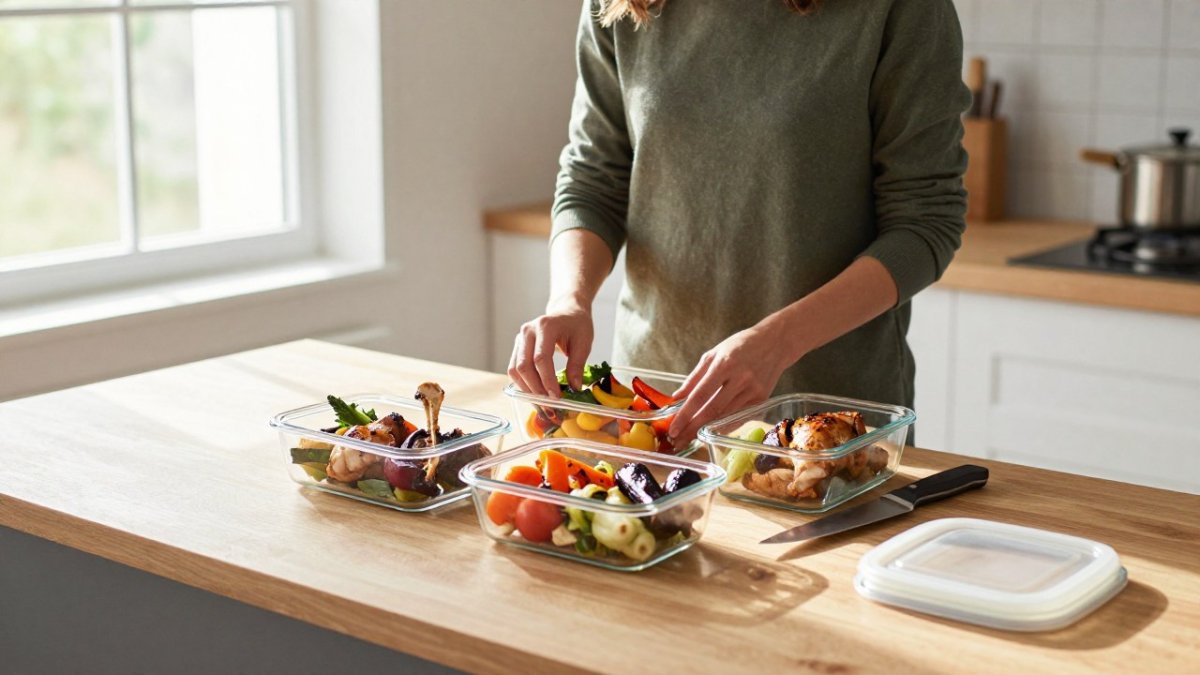
 How-to
How to Save Money on Grocery Shopping Weekly
Last Updated: November 15, 2026
Quick Summary
You can save money on grocery shopping weekly by replacing random trips with one repeatable routine: check your stock, plan 5-7 dinners, build a list, compare unit prices, shop once, and log your total. The workflow takes about 60 to 75 minutes a week, and your first budget should be 10 to 15 percent below your current baseline.
- Check your pantry, fridge and freezer first; it takes ten minutes and removes duplicates from your cart.
- Plan five dinners by category: one chicken or fish dish, one plant-based, one batch, one quick, one use-up dish.
- Compare unit price, not shelf price: a 1 kg box at $5.40 beats a 750 g box at $4.50 ($6.00 per kg).
- Bulk buying only wins when you will use it all, can store it, and the unit price is genuinely lower.
- Divide your weekly total by meals eaten to get cost per meal, like $140 for 28 meals at $5.00.
Table of Contents
- Why a Weekly Grocery Routine Beats Ad-Hoc Shopping
- Set a Weekly Grocery Budget You Can Actually Stick To
- Use Weekly Meal Planning to Save Money Without Eating the Same Thing
- Build a Grocery Shopping List on a Budget Before You Leave Home
- Compare Prices, Unit Prices, and When Bulk Buying Is Actually Cheaper
- How to Save Money on Groceries for One Person
- Common Grocery Shopping Mistakes That Raise Your Bill
- Track Your Weekly Savings and Let MealPrepGenius Automate the Plan
- Frequently Asked Questions
Why a Weekly Grocery Routine Beats Ad-Hoc Shopping
You can save money on grocery shopping weekly by replacing random trips with one repeatable routine: plan, check your stock, list, compare unit prices, and track what you spend.
Most people don't overspend because they're careless. They overspend because they shop without a system. A weekly routine turns grocery shopping into a short, predictable task instead of a series of small emergencies at 6pm.
The Real Cost of Shopping Without a Plan
Shopping without a plan costs you in three places. You buy duplicates of things you already own. You pay full price because you never checked the sales. And you throw out food you bought but never used.
The fix isn't discipline. It's structure: a short checklist you repeat on the same day each week, so the savings happen without willpower.
A Repeatable Weekly Workflow With a Realistic Time Budget
Here is the workflow we recommend. Total time is about 60 to 75 minutes a week, split across two short sessions.
| Step | What You Do | Time |
|---|---|---|
| 1. Check your pantry, fridge and freezer | Note what you already have | 10 min |
| 2. Plan the week's meals | Pick 5-7 dinners plus breakfasts and lunches | 15 min |
| 3. Build the list from the plan | Add only what the plan needs | 10 min |
| 4. Check sales and compare unit prices | Note substitutes for full-price items | 10 min |
| 5. Shop once, with the list | Stick to the list, allow one flexible item | 30-45 min |
| 6. Log your total and compare | Write down the spend for next week | 5 min |
Time
Do steps 1 to 4 on a quiet evening. Shop once. Then log the total, the step most people skip, and the one that shows you whether the routine is working.
Set a Weekly Grocery Budget You Can Actually Stick To
Start with what you actually spend, not what you wish you spent. Average your last four weeks of receipts or bank statements. That number is your baseline. Your first budget should be 10 to 15 percent below it, not half of it.
A budget that's too tight breaks in week two. One slightly lower than your baseline survives.
A Budget Breakdown Template by Household Size
Use this as a starting framework, then adjust to your area and diet. Treat the split as a guide, not a rule.
| Category | One person | Couple | Family of four |
|---|---|---|---|
| Fresh produce | 25% | 25% | 25% |
| Protein | 30% | 30% | 30% |
| Grains and staples | 15% | 15% | 15% |
| Dairy and alternatives | 10% | 10% | 10% |
| Frozen and canned | 10% | 10% | 10% |
| Treats and extras | 10% | 10% | 10% |
Write your total at the top of your list, then the running total as you shop. A running total stops the "I'll just grab this" spiral before it starts.
Use Weekly Meal Planning to Save Money Without Eating the Same Thing
Weekly meal planning to save money works because it kills two costs at once: impulse buys and food waste. The trick to avoiding boredom is planning by category, not by exact recipe.
Plan five dinners around a rotation: one chicken or fish dish, one plant-based dish, one slow-cook or batch dish, one quick dish, and one flexible "use up what's left" dish. Breakfasts and lunches repeat. That's normal, and it's where the savings live.
If you want ideas built from ingredients you already own, the Use What I Have tool suggests recipes from what's in your kitchen.
Sample Weekly Meal Plan and Itemized List at Two Budgets
Here is a sample week at two spending levels. Both use the same structure; the difference is protein choice and how much you buy fresh versus frozen.
| Day | Lower-budget dinner | Higher-budget dinner |
|---|---|---|
| Monday | Bean and vegetable chili | Chicken tray bake with potatoes |
| Tuesday | Lentil soup with bread | Salmon with rice and greens |
| Wednesday | Egg fried rice with frozen veg | Beef stir-fry with peppers |
| Thursday | Pasta with tomato and canned tuna | Pasta with fresh prawns |
| Friday | Baked potatoes with beans and cheese | Homemade burgers with salad |
| Breakfasts | Oats, bananas, eggs | Oats, yogurt, eggs |
| Lunches | Leftovers plus sandwiches | Leftovers plus salads |
Itemized list, lower budget: dried beans, lentils, rice, pasta, oats, eggs, canned tomatoes, canned tuna, frozen vegetables, potatoes, onions, carrots, bananas, bread, milk, cheese, cooking oil.
You can see full example plans at different budgets on the sample plans page.
Build a Grocery Shopping List on a Budget Before You Leave Home
A grocery shopping list on a budget is built from two things: your meal plan and your current stock. Never from memory. Write the list in the order your store is laid out, so you walk it once.
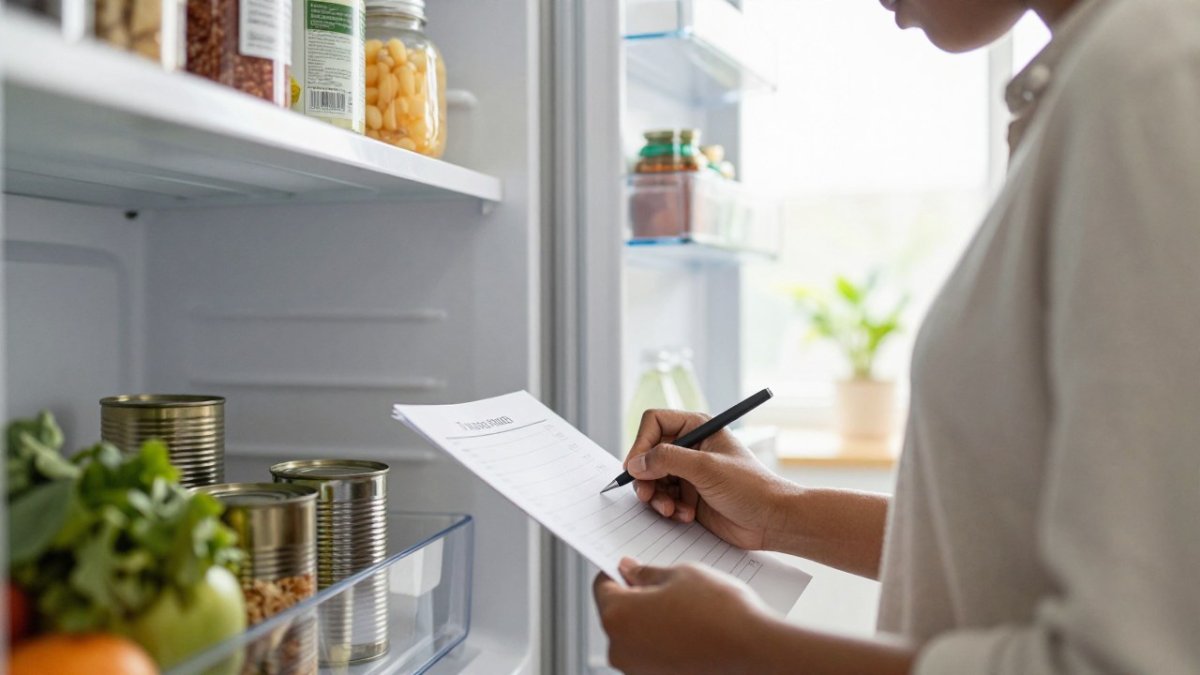
Group items by aisle: produce, protein, dairy, dry goods, frozen. Add a quantity next to each item. "Tomatoes" becomes "6 tomatoes." Quantity stops you buying a second jar of something already in the cupboard.
Check Pantry, Fridge, and Freezer First
Checking your stock before you write the list is the single highest-value step. It takes ten minutes and removes duplicates from your cart.
Open the freezer and look at the back. That's where the forgotten food lives. Then check the pantry for staples: rice, pasta, oil, canned goods.
A pantry tracker makes this faster. The MealPrepGenius pantry page keeps a running list of what you have, so you're not opening every cupboard each week.
Compare Prices, Unit Prices, and When Bulk Buying Is Actually Cheaper
Comparing prices means comparing the unit price, not the shelf price, the cost per kilogram, litre, or 100 grams, which most stores print on the shelf label.
A bigger pack is not automatically cheaper (A short guide to unit pricing). Retailers know shoppers anchor on pack size, so the "family" or "value" pack sometimes carries a higher unit price than the standard one.
The Break-Even Test for Bulk Buying
Bulk buying is only cheaper when three things are true at once:
- You will use all of it before it spoils or expires
- You have somewhere to store it without it degrading
- The unit price is genuinely lower than the smaller pack
Run a simple break-even before you buy. A 2 kg bag of rice at $6.00 ($3.00 per kg) beats a 1 kg bag at $3.60 ($3.60 per kg) by $1.20, but only if you finish the bag.
For nonperishable staples, rice, pasta, dried beans, oats, canned tomatoes, cooking oil, frozen vegetables, bulk usually wins because storage risk is low.
Storage Limits and Spoilage Risk
Storage capacity is part of the price. A bulk pack you cannot store properly is a bulk pack you will waste.
Bulk meat and fish need portioning the day you bring them home: divide into meal-sized portions, wrap tightly or vacuum-seal, label with the date, and freeze flat so they stack.
Watch out: warehouse-club membership fees and the cost of a second freezer are real costs.
When Bulk Is the Wrong Call
Skip bulk when you live alone or in a small household, have limited freezer space, the item is perishable, you are buying a new-to-you product you might not like, or the unit price is not actually lower. A common pattern is buying a large bag of a snack or cereal "because it's cheaper per ounce" and then eating more than planned, the unit price fell but the total spend rose.
How to Save Money on Groceries for One Person
Learning how to save money on groceries for one person comes down to buying smaller quantities and freezing the difference. Single households get hit hardest by waste, because most packs are sized for two or more.
Practical moves that work for one:
- Buy frozen vegetables instead of fresh for anything you won't eat within three days
- Buy meat in a family pack, then portion and freeze it on the day you shop
- Choose loose produce over pre-cut, which costs more per unit
Store brands matter more for one-person households. Generic staples like oats, rice, canned tomatoes and frozen vegetables are usually the same product at a lower unit price.
Common Grocery Shopping Mistakes That Raise Your Bill
The biggest mistake is shopping hungry and without a list. Both turn a planned shop into an impulse shop. The second biggest is shopping more often than you need to; each extra trip adds unplanned items.
Here are the mistakes we see most:
- Shopping without checking stock first. You buy a third jar of something you already have two of.
- Ignoring unit prices. The larger pack looks like value but costs more per gram.
- Skipping the sales check. A two-minute look at the weekly discounts often covers a whole meal.
A common mistake is treating coupons as savings on their own. A coupon for something you weren't going to buy isn't a saving; it's an extra purchase.
Track Your Weekly Savings and Let MealPrepGenius Automate the Plan
Tracking is how you find out whether the routine is actually saving money or just moving it around. The method below takes about five minutes a week and gives you two numbers that matter: your weekly total and your cost per meal.
A Simple Method for Measuring Savings Over Time
- Set a baseline. Average your last four weeks of grocery receipts or bank transactions. That number is what you were spending before the routine. Write it down.
- Record each week's total. Keep the receipt or log the total the same day you shop. Don't reconstruct it from memory a week later.
- Calculate cost per meal. Divide the weekly total by the number of meals the household actually ate from those groceries. If you spent $140 and ate 28 meals, that's $5.00 per meal. Cost per meal lets you compare weeks fairly, because a $120 week with three takeout dinners is not cheaper than a $140 week with none.
- Subtract weekly total from baseline. A positive number is a saving; a negative number is an overrun. Do this for four weeks and add the results, that sum is your monthly saving.
- Diagnose by category. Split each receipt into produce, protein, grains and staples, dairy, frozen and canned, and extras. If the total is over, the breakdown tells you where. Protein overruns usually mean too much fresh meat and not enough beans, eggs, or frozen fish. Extras overruns usually mean unplanned trips.
That's the whole method. No spreadsheet formulas required, a notes app or a paper log works.
Separating Real Savings From Moved Spending
A lower weekly total is not automatically a saving. Three patterns inflate the number:
- Stock-up weeks. If you bought a bulk pack of rice this week, the total looks high but next month's weeks look low. Average across four weeks, not one.
- Shifted spending. A week where you spent less on groceries but more on takeout is not a saving. Track takeout in the same log, or you will fool yourself.
- Waste you didn't count. If you spent $140 but threw out $20 of spoiled food, your effective cost per meal is higher than the receipt suggests. A quick end-of-week fridge check catches this.
Watch out: comparing your total to a friend's or to a national average is misleading. Household size, dietary needs, local prices, and how many meals you eat at home all change the number. Compare only to your own baseline.
Where MealPrepGenius Fits
This is where MealPrepGenius does the repetitive work. The platform generates personalized meal plans, turns them into an automated grocery list, and organizes batch-prep tasks so you cook once and eat across the week. Start from the weekly plan page to see how it fits your schedule.
The hard part of saving on groceries isn't knowing what to do. It's repeating the routine every week when work runs late and the fridge is empty.
Frequently Asked Questions
How can I lower my grocery bill every week without couponing?
The biggest lever is planning before you shop. Check your pantry, fridge, and freezer, then build a grocery shopping list on a budget from meals you already have ingredients for. Compare unit prices rather than shelf prices, choose store brands for staples, and buy only what your weekly meal plan needs. Shopping with a list and a set weekly grocery budget reduces impulse purchases, which is where most of the extra spending happens.
Is $100 a week for groceries reasonable?
It depends on household size, location, and diet. For one or two people, $100 a week is workable in most areas if you plan meals, use store brands, and cook at home. For larger families it may be tight. Rather than chase a fixed number, set your weekly grocery budget from your actual spending, then trim it in stages. Track your grocery bill for a month to see where the money goes before cutting.
How does weekly meal planning to save money actually work?
You pick meals for the week, list the ingredients each one needs, and shop only for those items. This cuts duplicate purchases, reduces food waste, and lets you plan around sale items and what is already in your kitchen. Plan two or three meals that share ingredients, such as a roast chicken that becomes soup and sandwiches, so nothing spoils. A tool like MealPrepGenius can generate the plan and shopping list together.
What is the 5-4-3-2-1 rule when grocery shopping?
It is a simple framework for building a balanced weekly shop: roughly 5 servings of vegetables, 4 of fruit, 3 of protein, 2 of dairy or alternatives, and 1 of grains or treats per day, scaled to your household. It is a guide, not a strict rule, and portions vary by person. The practical value is that it pushes you toward whole ingredients and seasonal produce, which usually cost less per meal than prepared and convenience foods.