 How-to
How to Meal Prep with Monthly Grocery Shopping
Last Updated: November 5, 2026
Quick Summary
Monthly grocery shopping means buying most of your food for four weeks in a single trip, then topping up fresh items between shops. Plan the month's meals first, build one master list from those meals, shop once or twice, prep in batches, and replenish fresh items weekly.
- Pick 12-16 dinners you actually like before writing your list.
- Order your list by store section to cut shopping time.
- Cook grains first, then roast vegetables, then proteins on prep day.
- Cool cooked food in shallow containers and refrigerate within two hours.
- Do one small weekly top-up for milk, salad, and fruit.
Table of Contents
- Why Monthly Grocery Shopping Makes Meal Prep Easier
- Building Your Monthly Grocery Shopping List
- A Monthly Grocery Shopping List for 1
- A Monthly Grocery List for a Family of 4
- How to Meal Prep with Monthly Grocery Shopping for a Week
- Meal Prep on a Budget: Tracking Costs and Cutting Waste
- Storage, Food Safety, and Fresh-Food Replenishment
- Start Your First Monthly Meal Prep with MealPrepGenius
- Frequently Asked Questions
Why Monthly Grocery Shopping Makes Meal Prep Easier
Monthly grocery shopping is the practice of buying most of your food for four weeks in a single trip, then topping up fresh items between shops. It cuts the number of store visits, reduces decision fatigue, and makes meal prep far easier to stick with. Fewer trips generally mean fewer impulse buys and fewer "what's for dinner" panics.
Here is the core tension most guides skip. A single big shop only works if your plan and your pantry are built for it. Buy four weeks of food without a plan and you get waste. Build a plan without storage space and you get spoiled produce.
The fix is a simple loop:
- Plan the month's meals first
- Build one master list from those meals
- Shop once or twice
- Prep in batches
- Replenish fresh items weekly
That loop is what this guide walks through, step by step. Below, we'll show you exactly how to run it for one person, for a family of four, and on a tight budget. First, though, here is the mistake that sinks most first attempts: shopping before planning.
Building Your Monthly Grocery Shopping List
A monthly grocery list is a meal plan turned into quantities. You start with the meals, check the recipe ingredients, then total them up. The list writes itself once the plan exists.
Follow these steps:
- Pick 12-16 dinners you actually like
- Open each recipe and note ingredient quantities
- Multiply each ingredient by how often you'll cook it
- Group duplicates so you buy one big bag, not four small ones
- Add breakfast, lunch, and snack basics
- Round up on shelf-stable items, down on fresh
The last step matters. Buying a little extra rice or frozen vegetables is cheap insurance. Buying extra salad greens is just waste.
Organizing by Store Sections
Order your list the way the store is laid out. This one habit cuts shopping time more than any app.
- Produce section
- Meat and fish counter
- Dairy and eggs
- Dry goods and grains
- Canned and jarred goods
- Frozen section
- Household and cleaning
Shop the perimeter last if your store puts fresh food there, so cold items spend less time in the cart. A common mistake is listing items by recipe instead of by aisle. You end up crisscrossing the store three times.
Pantry Staples and Dry Goods to Buy in Bulk
Bulk buying works best on items with a long shelf life. The Pantry page lets you track and manage the bulk pantry staples you've stocked up on. Focus your big purchases on dry goods and pantry staples: rice, pasta, oats, flour, dried beans, lentils, canned tomatoes, oil, and frozen vegetables.
Buy these in larger sizes:
- Grains and pasta
- Canned goods
- Frozen vegetables and fruit
- Cooking oil
- Nuts and seeds
Skip bulk buying for anything you'll use slowly and that spoils fast. A 5 kg bag of flour is a bargain if you bake. If you don't, it sits and goes stale.
A Monthly Grocery Shopping List for 1
A monthly grocery shopping list for 1 should be built around smaller packs and more frozen produce. Single households waste the most food on fresh items, so lean on frozen and shelf-stable basics.
A working template for one person, per month:
- Proteins: chicken thighs, eggs, canned tuna, lentils, tofu
- Grains: rice, pasta, oats
- Produce: onions, carrots, potatoes, frozen mixed vegetables, frozen berries
- Dairy: milk, cheese, yogurt
- Pantry: oil, canned tomatoes, stock cubes, spices
Cook in batches of two to three portions. Eat one, chill one, freeze one. That single habit is the difference between a plan that holds and one that collapses by week two.
A Monthly Grocery List for a Family of 4
A monthly grocery list for a family of 4 scales the same template up and adds flexibility. Buy family packs, portion them at home, and freeze what you won't cook in the first week.
Adjust your list like this:
- Double or triple protein quantities, then portion and freeze
- Buy the largest bags of rice, pasta, and oats
- Choose frozen vegetables for the bulk of your sides
- Add snack and lunchbox basics in bulk
- Keep one "flex" meal per week for leftovers
Household size changes storage needs, not the method. A family of four simply needs more freezer space and a firmer rule about eating leftovers before cooking fresh.
How to Meal Prep with Monthly Grocery Shopping for a Week
Learning how to meal prep with monthly grocery shopping for a week starts with one batch-cook session after your big shop. Cook once, portion into containers, and you have a week of prepared meals ready to go.
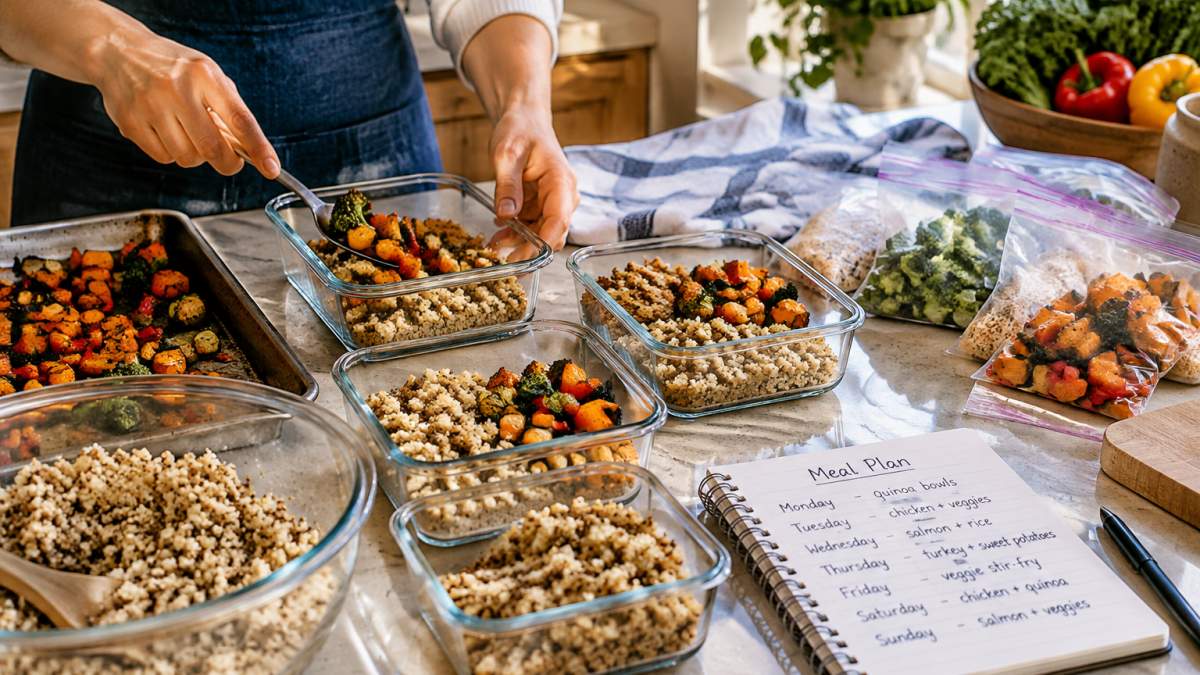
Here is a realistic seven-day workflow that fits around a single monthly shop.
Day 0 (shop day): Unpack with storage in mind. Wash and dry leafy greens, then store them with a paper towel in a sealed container.
Day 1 (prep day, roughly 2-3 hours): Cook in this order so nothing waits on a burner: grains first (rice, pasta, oats), then roast vegetables, then proteins. A common pattern is to cook two proteins at once, one for early-week meals and one to freeze. Cool everything in shallow containers before sealing. Portion the next three to four days into fridge containers and freeze the rest in single or double portions.
Day 2-4 (assembly days): Combine prepped bases into meals. Keep sauces and dressings separate so textures survive reheating. Move one frozen portion to the fridge each morning for the following day.
Day 5 (use-it-up day): Build a meal from what is left in the fridge before it turns. This is the day that protects your budget.
Day 6-7 (replenish and reset): Do a small fresh-items top-up for milk, salad, and fruit, then start the next week's batch from the freezer.
Sizing matters as much as sequencing. For one person, batch two to three portions per recipe: eat one, chill one, freeze one.
Watch out: cooling food in large deep pots and then refrigerating it slows cooling and creates a food-safety risk. Spread cooked food into shallow containers so it cools fast, and refrigerate within two hours of cooking.
Label every container with the food and the date. If you want the batch-cooking steps laid out for you, our batch prep workflow turns your shopping list into a task list.
Meal Prep on a Budget: Tracking Costs and Cutting Waste
Meal prep on a budget comes down to two habits: tracking what you spend and cutting what you throw away. Most households overspend on food in small leaks, not big purchases.
Track your spending with a simple sheet:
- List each item and its cost
- Divide total spend by number of meals
- Note what got thrown out
- Adjust next month's list
Cut waste with these moves:
- Plan "use-it-up" meals at the end of each week
- Freeze leftovers in single portions
- Store produce so it lasts: wash and dry greens, keep herbs in water
- Buy frozen when fresh tends to spoil
That last one is where a tool helps. Our use-what-I-have tool builds meals around pantry and bulk ingredients before they spoil, which is the fastest way to shrink waste.
Storage, Food Safety, and Fresh-Food Replenishment
Food safety is the part monthly shoppers get wrong most often. Buying a month of food only works if you store it correctly, know how long each category actually lasts, and know when to top up fresh items. This section gives you the practical timeline most guides skip.
Follow this storage timeline:
| Food Type | Fridge | Freezer | Pantry | Notes |
|---|---|---|---|---|
| Cooked meals | 3-4 days | 2-3 months | , | Cool fast, label with date |
| Raw poultry and meat | 1-2 days | 3-6 months | , | Freeze on shop day |
| Fresh vegetables | 3-7 days | 8-12 months blanched | , | Wash and dry before storing |
| Fresh fruit | 3-7 days | 6-12 months | , | Freeze ripe fruit for smoothies |
| Cooked grains | 3-4 days | 1-2 months | , | Portion before freezing |
| Dry goods (rice, pasta, flour, oats) | , | , | 6-12 months | Keep sealed and dry |
| Canned and jarred goods | , | , | 12+ months | Check dates, rotate stock |
| Frozen vegetables and fruit | , | 8-12 months | , | Keep at a steady temperature |
Thawing is where good storage goes wrong. Move frozen meals and raw protein to the fridge the night before you need them rather than thawing on the counter. If you are short on time, use the defrost setting on a microwave and cook immediately afterward. Never refreeze raw meat that has been thawed at room temperature.
For food-safety guidance on cooling, chilling, and reheating, the USDA Food Safety and Inspection Service guidance sets out the storage times and temperatures to follow.
Set up your storage before you shop, not after. Assess freezer and pantry space first, then buy containers that fit that space. Clear, stackable containers let you see what you have; flat freezer bags save the most room for soups, sauces, and portioned grains.
Replenish fresh items without a full trip. Do one small weekly top-up for milk, salad, and fruit, and keep a running list on the fridge so you buy only what you need. For foods that will not last a month, lean on frozen produce and shelf-stable alternatives: frozen spinach and berries, canned tomatoes, and root vegetables that hold for weeks.
Start Your First Monthly Meal Prep with MealPrepGenius
The challenge is not knowing the steps. It is running them every month without losing momentum. MealPrepGenius handles the planning and list-building so the loop above actually holds.
The platform generates personalized meal plans, automated grocery list generation, and batch-prep task management. It also includes progress tracking, so you can see what is working. If you want to see how a full month looks before you commit, browse sample plans to find a starting point.
Get started with MealPrepGenius and turn one monthly shop into four weeks of planned, prepped meals.
Frequently Asked Questions
How can you meal prep if you only shop once a month?
Split the month into two jobs: one big monthly grocery shopping trip for shelf-stable goods, frozen items, and proteins, then a short weekly prep session where you cook and portion from that stock. Buy fresh produce in the first two weeks and lean on frozen vegetables and fruit for the back half. Keep a running list of what runs out so the next monthly trip is accurate. A meal planning app can generate the list and prep tasks so you are not rebuilding the plan each week.
What foods can you buy monthly and store safely?
Dry goods like rice, pasta, oats, and lentils keep for months in sealed containers. Canned goods, frozen vegetables, frozen meat, and pantry staples such as oil and stock are all safe for a month or longer. Fresh produce is the limiting factor: root vegetables, cabbage, and squash last weeks in a cool, dark spot, while leafy greens and berries last days. Freeze bread and portioned meat on shopping day, and label everything with the date you stored it.
Is meal prepping cheaper than grocery shopping week by week?
It usually is, because buying in bulk lowers the cost per serving and planning meals around shared ingredients cuts waste. The savings come from three places: fewer impulse buys on extra trips, less food spoiling before you cook it, and buying protein and grains in larger packs. Track your receipts for two months to see your real numbers. Your monthly grocery shopping list should include a cost per serving estimate so you can compare against your previous spending.
How do you divide a monthly grocery haul into weekly meal prep?
On shopping day, wash and chop what you will use in week one, freeze proteins in meal-sized portions, and store dry goods in airtight containers. Each week, cook one batch of grains, one or two proteins, and roasted vegetables, then portion into containers for three to four days. Leave the rest frozen or shelf-stable until the following week. This keeps food fresh and means you only cook once or twice a week instead of daily.