 How-to
How to Meal Prep on a $50 Budget: 2026 Weekly Plan
Last Updated: October 24, 2026
Quick Summary
A meal prep $50 budget can cover seven days of breakfast, lunch, and dinner for one adult if you spend it on the right foods. Build the week on shelf-stable staples, frozen vegetables, and a few cheap proteins, then cook it all in one two-hour Sunday session.
- Split your $50 into four buckets: about $20 protein, $12 staples, $13 produce, and $5 extras.
- The grocery list is sized for one adult; scale up by multiplying the protein and produce lines first.
- Five core recipes make about 17 servings, giving you buffer for bigger appetites and leftovers.
- Cooked rice must be cooled within an hour, refrigerated immediately, and eaten within one day.
- Add roughly half again for a second adult and about a third for each child.
Table of Contents
- How to Meal Prep on a $50 Budget: What $50 Actually Buys
- Your Weekly Meal Plan Under $50 (7 Days of Meals)
- The $50 Grocery List for a Week (With Quantities)
- Cheap Meal Prep Ideas That Stretch Every Ingredient
- Meal Prep Recipes for the Week: 5 Core Recipes, 15 Meals
- Your Sunday Prep Workflow: 2 Hours, Food-Safe Storage
- Adapt the Plan: Household Size, Diet Swaps, and Price Changes
- Conclusion
- Frequently Asked Questions
How to Meal Prep on a $50 Budget: What $50 Actually Buys
A meal prep $50 budget can cover seven days of breakfast, lunch, and dinner for one adult if you spend it on the right foods. If you want to judge feasibility before committing, you can browse sample plans on MealPrep AI. This guide breaks down a full meal prep $50 budget week: what to buy, what it costs, and how to cook it in one Sunday session.
Cheap eating fails when it depends on fresh produce that dies by Wednesday. So we build the week on shelf-stable staples, frozen vegetables, and a few cheap proteins, adding fresh items only where they matter.
Below, we show you exactly how to meal prep on a 50 dollar budget with a shopping list, five recipes, and a two-hour prep workflow. One bag of rice covering nine meals beats nine single servings every time.
The $50 Rule: Where the Money Goes
Split your $50 into four buckets before you shop to avoid spending half the budget on meat by Thursday.
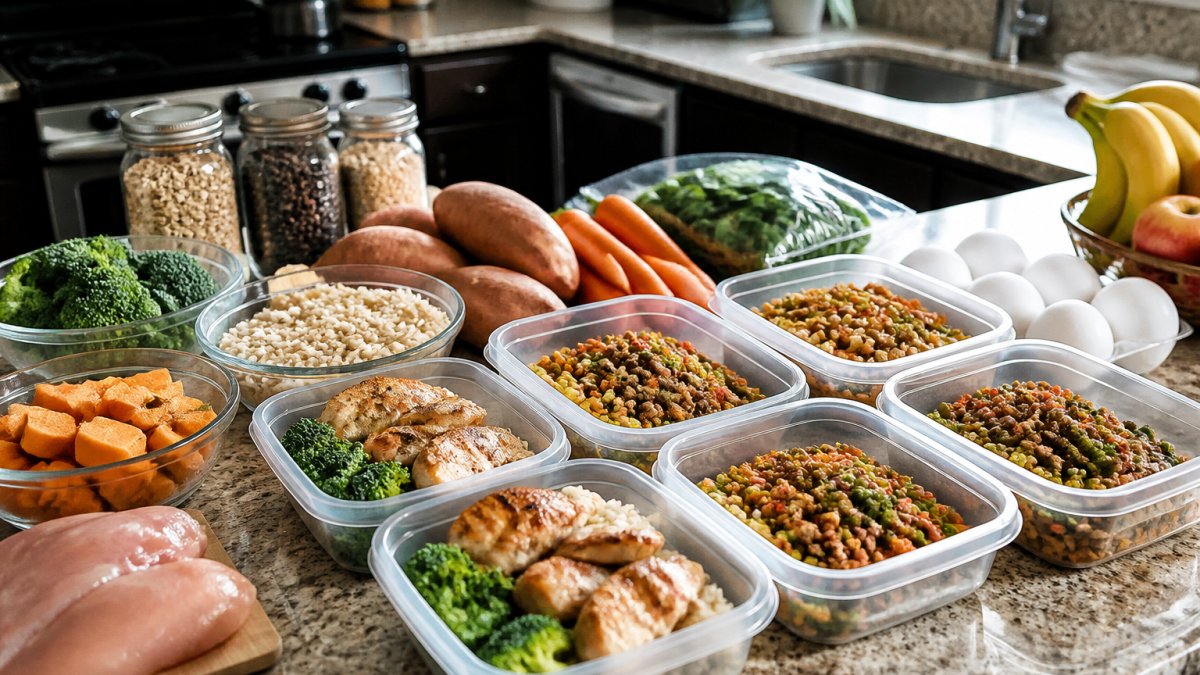
- Protein: about $20. Eggs, chicken thighs, canned tuna, beans, lentils.
- Staples: about $12. Rice, oats, pasta, potatoes, cooking oil.
- Produce: about $13. Frozen vegetables, onions, carrots, seasonal fresh fruit.
Prices swing by store and region, so treat these as targets. The split matters more than the exact numbers.
Your Weekly Meal Plan Under $50 (7 Days of Meals)
A weekly meal plan under $50 works when breakfast repeats, lunch rotates between two options, and dinner reuses one base recipe. If you like this sample week, you can generate and save your own weekly plan on MealPrep AI.
Breakfast, Lunch, and Dinner at a Glance
| Day | Breakfast | Lunch | Dinner |
|---|---|---|---|
| Mon | Oats with banana | Chicken rice bowl | Bean and vegetable soup |
| Tue | Oats with peanut butter | Bean soup + bread | Sheet-pan chicken and potatoes |
| Wed | Eggs on toast | Chicken rice bowl | Pasta with tomato and beans |
| Thu | Oats with banana | Pasta leftovers | Lentil soup |
| Fri | Eggs on toast | Lentil soup + bread | Sheet-pan chicken thighs |
| Sat | Oat pancakes | Rice and bean bowl | Vegetable pasta bake |
| Sun | Eggs and fruit | Soup from freezer | Leftover night |
Nothing is cooked twice from scratch: each dinner makes extra for lunch.
The $50 Grocery List for a Week (With Quantities)
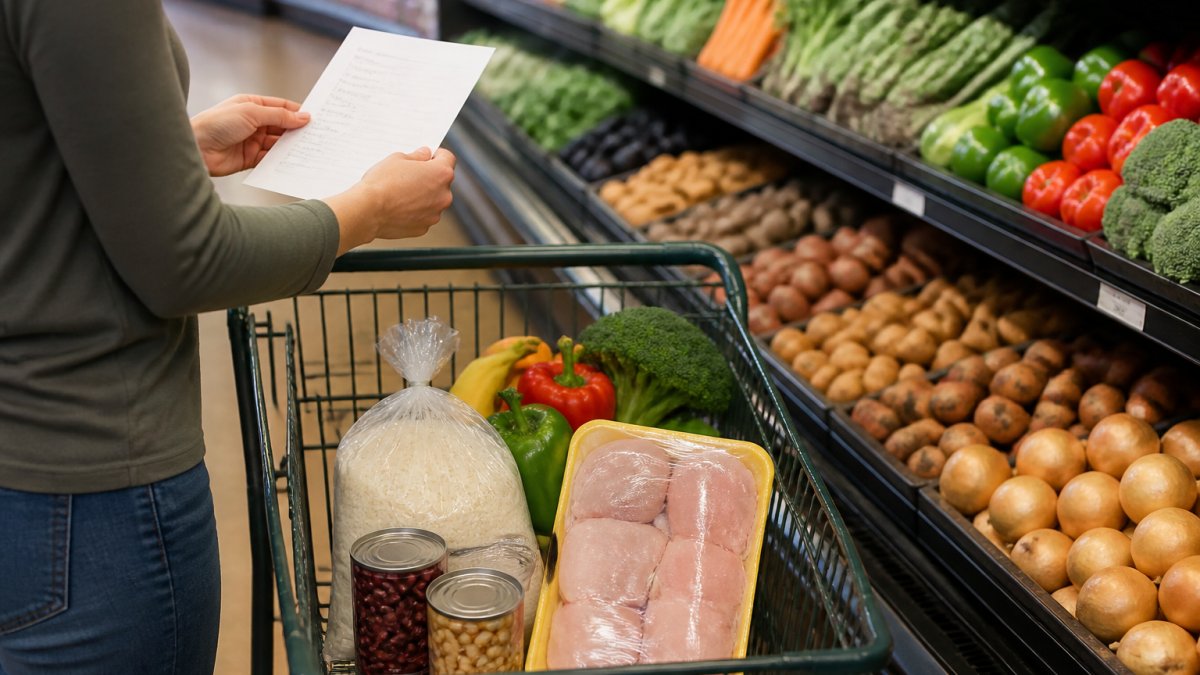
This $50 grocery list is sized for one adult; scale up by multiplying the protein and produce lines first. To turn this list into a usable, checkable shopping list, open the grocery list page on MealPrep AI.
Protein and dairy
- Eggs, 12-count
- Chicken thighs, 1 pack (about 1 kg)
- Canned tuna, 2 cans
Grains and staples
- Rolled oats, 1 kg bag
- White rice, 1 kg bag
- Pasta, 2 packs
Produce
- Frozen mixed vegetables, 1 large bag
- Onions, 3
- Carrots, 1 bag
That list lands near $50 at most supermarkets. If your total runs over, drop the tuna and bread first.
Itemized Cost Sheet: What Each Line Actually Costs
Below is a receipt-style breakdown to check against your own store. Prices are typical mid-range supermarket figures and vary by region and season, so treat each line as a target.
| Item | Pack size | Typical unit price | Cost per serving |
|---|---|---|---|
| Eggs | 12-count | $3.00 | $0.25 per egg |
| Chicken thighs | ~1 kg | $6.50 | ~$1.10 per 150 g serving |
| Canned tuna | 2 cans | $2.00 | $1.00 per can |
| Canned beans | 3 cans | $2.70 | ~$0.45 per half-can serving |
| Dried lentils | 500 g | $1.50 | ~$0.15 per 50 g dry serving |
| Milk or yogurt | small carton | $1.50 | ~$0.25 per cup |
| Rolled oats | 1 kg | $2.50 | ~$0.12 per 50 g serving |
| White rice | 1 kg | $1.80 | ~$0.18 per 100 g dry serving |
| Pasta | 2 packs | $2.00 | ~$0.25 per 100 g serving |
| Potatoes | 1 kg | $1.50 | ~$0.30 per 200 g serving |
| Bread | 1 loaf | $2.00 | ~$0.20 per slice |
| Cooking oil | small bottle | $2.50 | pennies per use |
| Canned tomatoes | 2 cans | $2.00 | ~$0.50 per half-can |
| Peanut butter | small jar | $2.50 | ~$0.20 per tablespoon |
| Frozen mixed vegetables | 1 large bag | $3.00 | ~$0.30 per cup |
| Onions | 3 | $1.50 | ~$0.25 each |
| Carrots | 1 bag | $1.50 | ~$0.15 per carrot |
| Bananas | 1 bunch | $1.50 | ~$0.25 each |
| Seasonal fruit | cheapest available | $2.50 | varies |
Add the column and you land near $50 for the week. Chicken, eggs, and canned tuna drive the total most; oats, rice, lentils, and frozen vegetables make the week affordable.
Cost Per Serving and Nutrition Snapshot
Cost per serving tells you whether a plan is actually cheap. Here is how the core meals break down:
- Oats with banana: about $0.40 per bowl, roughly 300 calories and 8 g protein.
- Eggs on toast: about $0.70 per serving, roughly 280 calories and 14 g protein.
- Chicken rice bowl with frozen vegetables: about $1.60 per serving, roughly 550 calories and 35 g protein.
Across a full day, the plan lands near $5 to $7 in food cost and roughly 1,800 to 2,200 calories. If your day is light on protein, add an egg or a half-can of beans rather than buying more meat.
Adjusting the List When Prices Differ
Build the list around your store's weekly deals and fill gaps with staples. A few rules keep the total near $50:
- If chicken is expensive, shift the protein bucket toward eggs, canned tuna, and lentils. You lose variety, not nutrition.
- If produce is expensive, lean harder on frozen vegetables and root vegetables, which hold up all week.
- If you already own rice, oats, or oil, subtract those lines and put the savings into protein or fruit.
If you already have rice, oats, or beans in the pantry, our platform can help you incorporate those into your meal plans before you shop.
Cheap Meal Prep Ideas That Stretch Every Ingredient
Cheap meal prep ideas work by stretching one ingredient across several meals, cook once, eat three times, freeze the rest:
- One chicken pack, three meals. Roast it Sunday. Use half for rice bowls, shred the rest into soup and pasta.
- Beans do double duty. Canned beans go into soup and into a cold rice bowl the next day.
- Lentils replace meat. A lentil soup costs a fraction of a meat dish and freezes well.
A common mistake is buying fresh spinach and herbs for a seven-day plan. They wilt by day three. Buy frozen instead, and add fresh produce only for the first two days.
Meal Prep Recipes for the Week: 5 Core Recipes, 15 Meals
Five recipes cover the whole week. Each makes two or three servings, reaching fifteen meals without cooking every day.
- Big-batch rice and chicken bowls. Cook rice, roast chicken thighs with oil and spices, add frozen vegetables. Makes 3 servings.
- Bean and vegetable soup. Onion, carrot, canned tomatoes, beans, stock or water, spices. Makes 4 servings and freezes well.
- Lentil soup. Dried lentils, onion, carrot, canned tomatoes. Cheap, filling, and better on day two. Makes 4 servings.
- Tomato and bean pasta. Pasta, canned tomatoes, beans, garlic, oil. Makes 3 servings.
- Sheet-pan chicken and potatoes. Chicken thighs and potato chunks on one tray with oil and seasoning. Makes 3 servings.
Total: about 17 servings, which gives you buffer for bigger appetites and leftovers.
Your Sunday Prep Workflow: 2 Hours, Food-Safe Storage
Two hours on Sunday covers the entire week. If you are ready to batch-cook, a guided batch prep tool on MealPrep AI can help you execute this Sunday workflow. Order matters more than speed: start the longest items first and prep while they cook.
The Timed Sequence
0-10 minutes: heat and start. Heat the oven to 425°F (220°C). Get chicken and potatoes on a tray with oil and seasoning and slide it in. Start a large pot of rice and a second pot of water for pasta.
10-40 minutes: build the soups. While the tray roasts, chop onions and carrots.
40-70 minutes: pasta and cooling. Boil pasta, drain, and spread it on a sheet pan to cool fast.
70-100 minutes: portion into containers. Fill containers by meal, not by ingredient. Label each with the day and the reheat instruction.
100-120 minutes: store and freeze. Refrigerate the first three days. Freeze the rest in single-serving portions so you thaw only what you need.
Container Plan
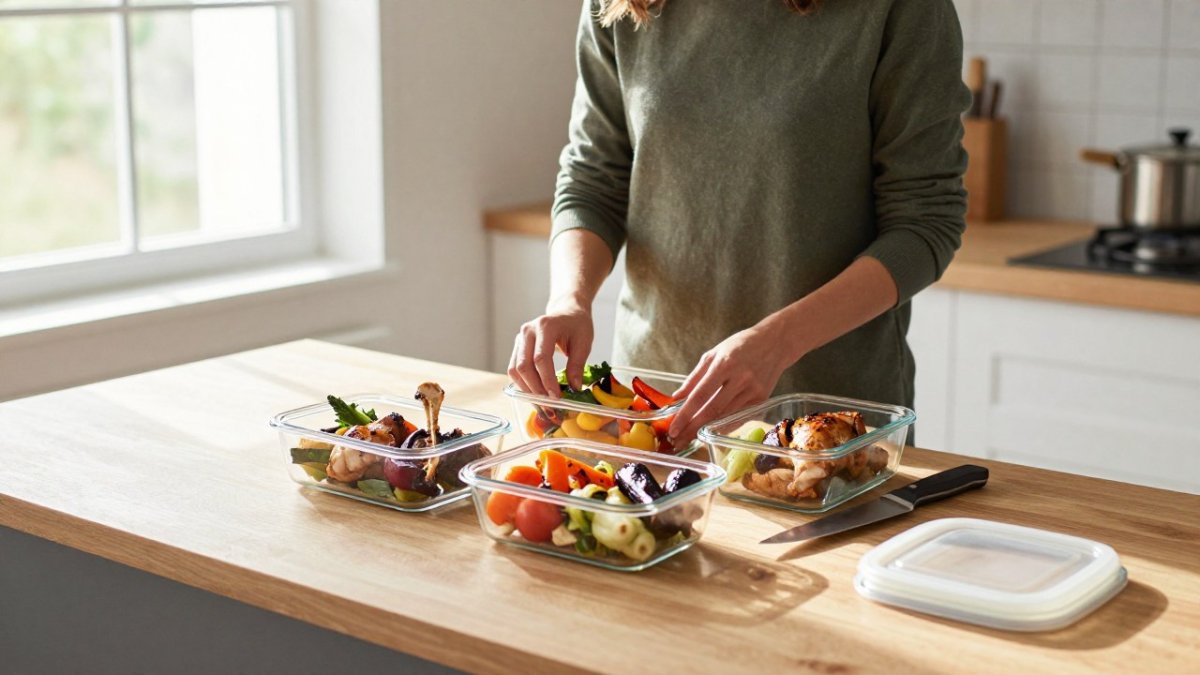
Use clear, stackable containers so you can see what you have:
- Five to seven single-serving containers for lunches and dinners you will eat within three days.
- Two to three larger containers for soups you will portion out during the week.
- Freezer bags or flat containers for the portions you freeze; flat packs thaw faster and stack better.
Portion by meal rather than by ingredient, rice, chicken, and vegetables reheat as one unit.
Refrigeration and Freezing Limits
Cool cooked food fast and refrigerate within two hours. For this plan:
- Cooked rice: cool within an hour, refrigerate immediately, and eat within one day. Never leave rice sitting out at room temperature.
- Soups and pasta: refrigerate for up to three days, or freeze for up to three months.
- Cooked chicken: refrigerate for up to three days, or freeze for up to three months.
What to Prep Fresh vs. What to Freeze
Not everything survives a week in the fridge:
- Freeze: soups, lentil soup, pasta with tomato and beans, and any chicken you will not eat by Wednesday.
- Refrigerate and eat early: rice bowls, sheet-pan chicken and potatoes, and anything with fresh produce added.
- Prep fresh midweek: bananas and seasonal fruit, which you can slice or eat whole rather than pre-cut.
If you would rather have the steps laid out for you, our batch-prep task management feature can help build a task list and timing around your own recipes.
Adapt the Plan: Household Size, Diet Swaps, and Price Changes
The plan scales simply: add roughly half again for a second adult and about a third for each child. A family of four lands near double the base list, not four times.
Diet swaps that keep the budget intact:
- Vegetarian: drop chicken, add extra beans, lentils, and eggs.
- Gluten-free: swap bread and pasta for rice, potatoes, and gluten-free oats.
- Higher protein: add eggs and canned tuna before adding expensive meat.
Check your local store's weekly deals before you commit and fill gaps with staples. To build meals from what you already have in your pantry, try Use What I Have on MealPrep AI.
Conclusion
Feeding yourself well for $50 a week comes down to structure, not willpower: shared ingredients, a fixed breakfast, batch cooking, and honest storage.
MealPrepGenius makes that structure repeatable through personalized meal plans, automated grocery list generation, and batch-prep task management.
Get started with MealPrepGenius to simplify your meal planning and preparation.
Frequently Asked Questions
What is the 3-3-3 rule for meal prep?
The 3-3-3 rule is a simple framework: prepare three different proteins, three different grains or starches, and three different vegetables. That gives you nine building blocks you can mix into at least nine different meals across the week. On a $50 budget, the rule works well because you buy in bulk and repeat ingredients in different combinations. For example, cook chicken thighs, eggs, and beans as proteins; rice, potatoes, and pasta as starches; and frozen broccoli, carrots, and onions as vegetables. You get variety without buying fifteen separate items.
How do I make a $50 grocery list for a week of meals?
Start with the cheapest protein sources: eggs, chicken thighs, canned or dried beans, and tofu. Then add a base starch like rice, potatoes, or pasta, plus frozen vegetables and one or two fresh items on sale. Write the list by meal, not by aisle, so you know exactly what each item is for. A typical $50 list for one person includes 18 eggs, 1 kg chicken thighs, 2 cans of beans, 1 kg rice, 1 kg potatoes, 1 kg frozen mixed vegetables, 1 jar of pasta sauce, and 1 loaf of bread. Check unit prices and buy store brands where possible.
How long can meal-prepped food stay in the fridge?
Cooked meal-prepped food generally stays safe in the fridge for three to four days. Store it in shallow, airtight containers so it cools quickly, and keep the fridge at or below 4°C. If you are prepping for a full seven days, freeze the portions you plan to eat on days four through seven and thaw them in the fridge the night before. Label each container with the date. Reheat leftovers to steaming hot, and never refreeze food that has already been thawed and reheated.
What are the cheapest foods to buy for meal prep?
The cheapest foods for meal prep are eggs, dried or canned beans, lentils, rice, potatoes, oats, frozen vegetables, chicken thighs, and store-brand pasta. These items deliver a low cost per serving and keep well. Frozen vegetables often cost less than fresh and reduce food waste because you use only what you need. Buying dried beans instead of canned cuts the price further, though it adds soaking and cooking time. Build your weekly meal plan around these staples first, then add fresh produce that is in season or on sale.