 How-to
Can Meal Planning Reduce Decision Fatigue?
Last Updated: October 28, 2026
Quick Summary
Meal planning reduces decision fatigue by deciding your meals ahead of time so you make fewer food choices each day. Instead of asking what to cook three times a day, you answer it once a week in a single planning session, which moves food decisions out of your daily mental budget.
- Decision fatigue is mental exhaustion from many choices, not a lack of willpower.
- Pick 3 to 5 dinners, not 7, and repeat meals freely.
- Batch prep parts of meals, like one grain, one protein, and one sauce.
- Set dietary restrictions once in your planning tool instead of deciding daily.
- Keep a fallback list with two freezer meals and one pantry meal.
Table of Contents
- Why Choosing What to Eat Drains Your Mental Energy
- How to Plan Meals for a Week in One Sitting
- A Weekly Meal Plan Template You Can Reuse
- Meal Prep for the Week: Batch Tasks That Cut Cooking Decisions
- Meal Planning With Dietary Restrictions Without Extra Mental Load
- Your Low-Energy Fallback Plan for Weeks That Fall Apart
- Building Your First Decision-Light Meal Plan in MealPrepGenius
- Frequently Asked Questions
Why Choosing What to Eat Drains Your Mental Energy
Every meal you plan in advance is one less decision you have to make later. That is the core idea behind using meal planning to reduce decision fatigue, and it works because your brain has a limited daily budget for choices. By 6 p.m., the question "what's for dinner?" can feel harder than it should.
Decision fatigue is the mental exhaustion that builds up after making many choices in a day. It is not a lack of willpower. It can feel like a drain on mental energy.
What Decision Fatigue Means for Food Choices
Decision fatigue shows up in the kitchen as food stress. You open the fridge, stare at the food in it, and close the door again. You order takeout because picking a recipe feels like too much work.
The pattern is predictable:
- You make dozens of small choices before dinner
- Your mental energy runs low
- The easiest food option wins, not the healthiest one
Some people reach for convenience foods at night. It is not laziness.
How Meal Planning Reduces Daily Food Decisions
Meal planning is the practice of deciding your meals ahead of time so you make fewer food choices each day. Instead of asking "what to cook" three times a day, you answer it once a week.
A weekly meal plan can move food decisions into one planning session.
Here is what changes when you plan ahead:
- Dinner stops being a daily debate
- Your grocery list writes itself from the plan
- Healthy choices become the default, not a struggle
How to Plan Meals for a Week in One Sitting
Build a weekly plan in one sitting. The goal is not a perfect plan. It is a plan you can follow without thinking. A fixed, repeatable workflow can provide structure.
Here is a reusable weekly workflow you can run in one sitting:
- Open your calendar first. Note late meetings, kids' activities, travel, and nights out. Mark those as "flex" or "leftovers" nights before you choose a single recipe. Planning around your schedule can help you account for changes during the week.
- Audit the fridge, freezer, and pantry. List what needs using first, the half bag of spinach, the open jar of salsa, the chicken in the freezer. Build dinners around those items.
- Pick 3 to 5 dinners, not 7. Repeat meals are fine. Choose one sheet-pan meal, one stovetop meal, one no-cook or assembly meal, and one flexible "use-it-up" night.
- Plan breakfasts and lunches. Keep them the same most days.
- Add one or two theme nights. Taco Tuesday or pasta Friday can give the week a rhythm your household can predict.
- Build your grocery list from the plan. Add what the plan needs, plus your staple restock list. Cross off anything the pantry audit already covered.
- Flag batch prep tasks. Note anything you can cook ahead, a grain, a protein, a sauce, and schedule a prep session.
Planning seven brand-new recipes can create more work. Repeating meals is one option. Checking the pantry before planning can help you account for food you already have.
If you want to see how this workflow looks filled in, review sample plans and copy the structure rather than the specific meals.
A Weekly Meal Plan Template You Can Reuse
A reusable weekly meal plan template is a fixed structure you fill in each week. It can give you a starting point.
Here is a simple template to copy:
| Day | Breakfast | Lunch | Dinner | Prep Note |
|---|---|---|---|---|
| Monday | Overnight oats | Leftover grain bowl | Sheet-pan chicken and veg | Cook extra chicken |
| Tuesday | Eggs and toast | Chicken salad | Pasta with tomato sauce | Boil pasta ahead |
| Wednesday | Yogurt and fruit | Pasta leftovers | Stir-fry with rice | Cook rice in bulk |
| Thursday | Overnight oats | Rice bowl | Tacos | Brown the meat |
| Friday | Eggs and toast | Taco bowl | Homemade pizza | Grate cheese early |
| Saturday | Pancakes | Leftovers | Flexible night | Use up fridge food |
| Sunday | Yogurt and fruit | Simple soup | Batch cook day | Prep for the week |
You can see sample plans to model your own template on. Once the structure is set, each week is just fill-in-the-blank.
Meal Prep for the Week: Batch Tasks That Cut Cooking Decisions
Batch prep means cooking parts of meals in bulk once, then mixing them into meals during the week.
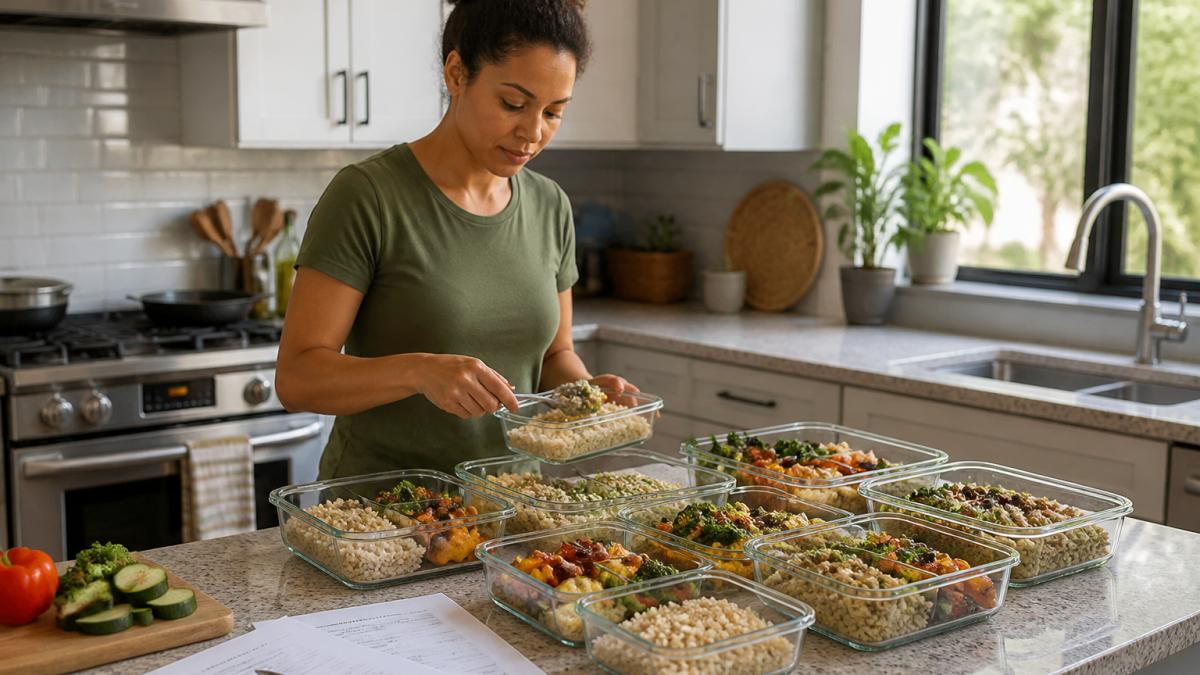
Batch prep tasks can include:
- Cook one grain in bulk: rice, quinoa, or pasta for the week
- Roast a tray of vegetables: peppers, onions, and squash keep well
- Cook protein once: chicken, beans, or ground meat for multiple meals
- Wash and chop produce: ready-to-grab snacks and salad parts
- Make one sauce: a big batch covers several dinners
Batch prep can focus on parts of meals rather than full meals. You do not have to cook seven dinners on Sunday. You can start with batch prep tasks to see how this works in practice.
Meal Planning With Dietary Restrictions Without Extra Mental Load
Meal planning with dietary restrictions can involve setting your preferences and using them to guide meal choices. Household size, dietary restrictions, budget, cooking skill, and differing preferences can all affect what a workable plan looks like.
Here is how to adapt the method instead of following generic advice:
- Set your restrictions once. Enter allergies, intolerances, and dietary patterns (gluten-free, vegetarian, halal, low-sodium) into your planning tool so every generated plan respects them. This removes the daily "is this okay for everyone?" question.
- Build meals around a shared base. Choose a base that works for everyone, rice, pasta, potatoes, or salad, then add protein and sides per person. A vegetarian spouse and a macro-focused eater can share the same base with different toppings, which keeps one cooking session instead of two.
- Match plan complexity to your cooking skill and time. If you are a beginner or short on time, favor sheet-pan meals, one-pot meals, and assembly meals. If you enjoy cooking, reserve one weekend session for a more involved recipe and keep weeknights simple.
- Plan to your budget, not an idealized list. Set a rough weekly grocery target and let the plan drive the list. Build two dinners around ingredients already on hand, and use one flexible "use-it-up" night to clear the fridge before the next shop.
- Keep safe staple ingredients on hand. A gluten-free pasta, a canned bean, a frozen vegetable, and a jarred sauce give every household a fallback meal that fits most restrictions.
- Use a flexible meal plan that lets you swap one item without rebuilding the week. If a restriction or preference changes, swap the single meal rather than starting over.
For households with mixed needs, a gluten-free kid, a vegetarian spouse, and a macro goal for you, meal planning can involve several considerations. Treating restrictions as part of the planning process can help organize meal choices.
Your Low-Energy Fallback Plan for Weeks That Fall Apart
A low-energy fallback plan is a short list of meals you can turn to when the week goes sideways.
Build your fallback list now, while you have energy:
- Two freezer meals you can heat and eat
- One pantry meal from staple ingredients, like pasta and beans
- One breakfast-for-dinner option that needs no planning
- One takeout night you have already budgeted for
When a week falls apart, you can use the fallback rather than re-plan from scratch. The Swap Coach lets you swap a single meal without rebuilding the week. A fallback list can give you options when you need a different meal mid-week.
Building Your First Decision-Light Meal Plan in MealPrepGenius
The point is to get a working plan in front of you, then adjust as you go.
Here is how to build your first plan:
- Set your food preferences so the plan respects your diet and goals
- Generate your plan for the week in one step
- Review the grocery list the plan builds for you
- Check the batch prep tasks and schedule one prep session
- Save your fallback meals for the week that goes sideways
When you are ready to create a plan, you can start with a working week instead of a blank page.
Frequently Asked Questions
How does meal planning reduce decision fatigue?
Planning meals can move some food decisions into a weekly session. A fixed weekly meal plan, staple ingredients, and batch prep are ways to organize meals ahead.
What is the easiest way to start meal planning?
Start with dinners for the first week, repeat two or three simple meals you already cook, and build a grocery list around those. A weekly meal plan template can provide a structure to fill in. You can extend the same approach to breakfast and lunch, or use a meal-planning app to help organize your plan and grocery list.
How many meals should I plan for the week?
You can plan dinners plus a repeatable breakfast and lunch. That can cover multiple meals without requiring a different recipe for each one. Repeating breakfasts and rotating dinners are options to consider when organizing food shopping and batch prep.
How can I simplify meal planning with dietary restrictions?
Consider household restrictions when choosing staple ingredients and planning meals. For mixed needs, such as gluten-free, vegetarian, and specific macros, review recipes and portions to check that they fit the household's requirements. A fallback list can help organize meal options.
Decision fatigue wins when every meal is a fresh choice. Meal planning wins when you decide once and let the structure carry you. MealPrepGenius makes that structure easy with personalized meal plans, automated grocery lists, and batch-prep task management, so you spend less time deciding and more time eating well. Get started with MealPrepGenius and turn a week of food decisions into one simple plan.